Meaning, symbolism, healing traditions, uses and care
Hematite
Hematite is an iron oxide that can look almost like metal: polished, it shines silver-gray, gunmetal or nearly black. In contemporary crystal practice it is the stone of grounding and steadiness, connected with the Root.
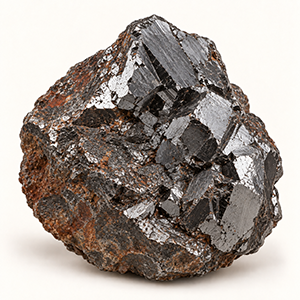
Scratch or grind it, though, and something unexpected appears: red. Its name comes from an ancient Greek word connected with blood, and long before it was a grounding stone, humans were grinding iron-rich minerals into red pigment.
At a glance
- Color
- Steel-gray, silver-gray, blackish or earthy red
- Mineral
- Hematite, an iron oxide (Fe₂O₃)
- Hardness
- About 5 to 6 on the Mohs scale
- Streak
- Distinctive reddish brown to rust-red
- Appearance
- Metallic, submetallic or earthy depending on form
- Availability
- Very widespread
- Energy center
- Root
Hematite is one of the world’s most important iron-bearing minerals, and it takes surprisingly different forms: reflective metal, rounded botryoidal masses, sparkling plates or soft red earth. Yet even a specimen that looks almost black reveals its iron-red character when powdered.
What hematite represents today
In contemporary crystal and metaphysical traditions, hematite is associated with grounding, stability and focus, with strength as steadiness, and with boundaries that keep you inside your own center rather than walling the world out. Where stones for the upper energy centers reach toward intuition, hematite brings attention down: to the body, the ground and what is happening here.
Its iron, its name and its red streak have also linked it, in some traditions, with blood and vitality. That link is symbolic. Hematite is not a source of dietary iron and not a treatment for any blood or circulation condition.
A short history
Hematite has one of the deepest human histories in the Crystal Library. At Twin Rivers in Zambia, archaeologists found hematite pigment showing signs of grinding or rubbing from around 250,000 years ago: an extraordinarily early chapter in symbolic human behavior. Much later, its dark metallic polish made it fashionable in Victorian mourning jewelry.
A foundation, quite literally
Hematite is also one of the principal ores of iron, and iron is the basis of steel. The same mineral sold as a polished grounding stone runs through bridges, railways and machinery. Few stones carry the idea of a foundation so literally.
What people often misunderstand about hematite
The common shortcut is: I feel scattered, so I need hematite. But “scattered” can describe very different inner situations.
One person feels scattered because too many thoughts compete for attention, and a firmer connection to the body and practical reality may be exactly right. Another feels scattered because they are exhausted. More weight is not what is missing there.
Stability works the same way. Some people need stronger foundations. Others have built so much structure around themselves that little room is left for spontaneity, creativity or emotional movement. For them, more grounding can tighten what is already tight.
Stability is not always created by adding weight. Sometimes it comes from being flexible enough to stay centered while life moves.
When hematite may not be what you need
If you already feel emotionally heavy, rigid or tightly controlled, and what you long for is movement, softness or openness.
If practical responsibilities fill your days and you rarely make room for imagination, pleasure or creativity.
If you are highly disciplined but have lost touch with enthusiasm: something activating may matter more than extra structure.
If you protect your energy by withdrawing or closing off, stronger containment may not be the missing piece.
None of this makes hematite too heavy for anyone. Sometimes its steadiness is exactly what is needed; sometimes the moment asks for a different kind of support.
The My Crystal Code view
Grounding is a quality, not a prescription
Hematite’s meaning is one of the clearest there is: it points down, toward the ground. But a clear meaning still describes the stone, not you. Knowing what a crystal traditionally represents is not the same as knowing whether it is the right crystal for you right now. My Crystal Code looks at the whole person before suggesting any support.
How people use hematite
- Grounding meditation: Hold a polished stone, or place it near the feet, while you meditate.
- Body awareness: Hold it while attending to breath, feet or physical sensation; its weight and cool surface are part of the experience.
- Desk or study space: Keep it nearby when the intention is focus or practical concentration.
- Busy places: Some people wear it as a bracelet or beads in busy environments, as part of an energetic-boundary practice.
- Pairing: Combine it with protective stones such as black tourmaline or obsidian, or with lighter crystals to balance its density.
Caring for hematite
- Cleaning: Lukewarm water, mild soap and a soft cloth; gentle hand cleaning is usually enough.
- Ultrasonic and steam: Avoid ultrasonic and steam cleaners.
- Impact: Protect polished pieces from hard knocks, because hematite can chip or fracture.
- Chemicals: Avoid harsh household chemicals.
- Storage: Keep it apart from harder gemstones that could scratch its polished surface.
- Jewelry: Beads can scratch or chip when knocked against harder materials. Dry jewelry thoroughly after cleaning.
Questions people often ask
Why is it called hematite?
Its name comes from an ancient Greek word connected with blood, after the red color of its powder. The link was visual and symbolic.
Why does hematite look gray if its streak is red?
Dense hematite reflects light in a way that looks metallic gray or nearly black. Ground fine, its red iron-oxide color shows: that powder is red ochre, one of humanity’s oldest pigments.
Is magnetic hematite real hematite?
Usually not. Natural hematite is at most weakly attracted to a strong magnet. Beads that snap to one another are usually a manufactured ferrite. The streak is less reliable, because some imitations also leave a reddish mark.
Can hematite go in water?
Briefly, yes. Gentle cleaning with water suits solid polished hematite; long soaking is unnecessary. Dry it thoroughly, especially jewelry with metal settings or stringing.
Is hematite the right crystal for me?
It may be. Its meaning describes the stone. Whether its steadiness is what you need right now is a personal question, and that is where My Crystal Code begins.
Discover which crystals fit you right now
Hematite’s meaning points toward the ground. The next question is whether that is where your support belongs right now.
Start your readingSources
- Gemological Institute of America (GIA): Hematite as a historical pigment, gemstone and Victorian mourning material.
- U.S. Geological Survey and mineralogical references: Hematite as Fe₂O₃, its role as a major iron ore mineral and its industrial importance.
- International Gem Society: Hematite, its magnetic imitations and its care.
More in the Crystal Library
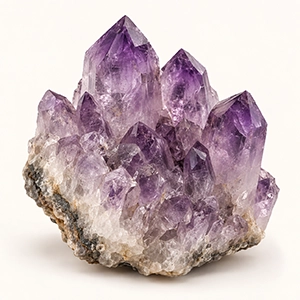 Amethyst
Purple quartz, once a stone of sobriety, linked today with calm and clarity.
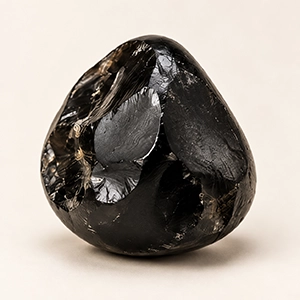 Apache Tear
Small obsidian pebbles from Arizona perlite, linked today with grief and release.
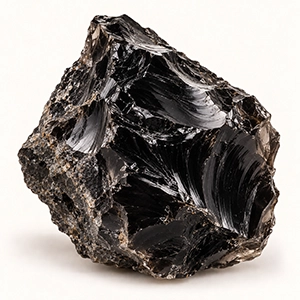 Black Obsidian
Natural volcanic glass, once blades and mirrors, linked today with grounding.
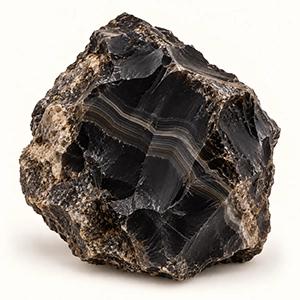 Black Onyx
Black chalcedony of Roman intaglios and cameos, linked today with boundaries.
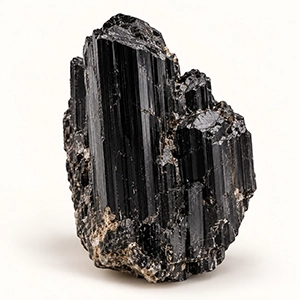 Black Tourmaline
Black schorl tourmaline, a record of the rocks it grew in, linked today with protection.
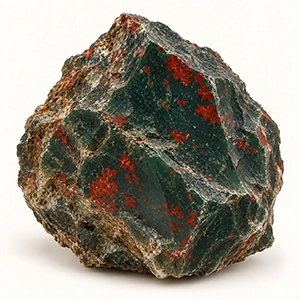 Bloodstone
Green stone flecked with red, the heliotrope of Rome, linked today with courage.
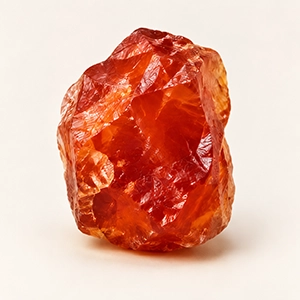 Carnelian
Orange-red chalcedony, carved since the Indus Valley, linked today with vitality.
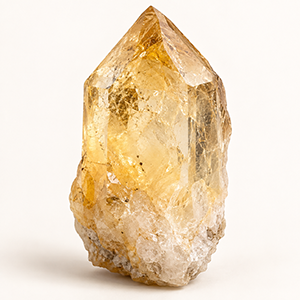 Citrine
Golden quartz, often heated amethyst, linked today with confidence and abundance.
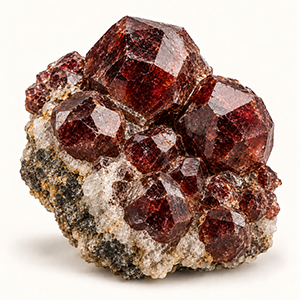 Garnet
A family of deep red gems, worn since ancient Egypt, linked today with vitality.
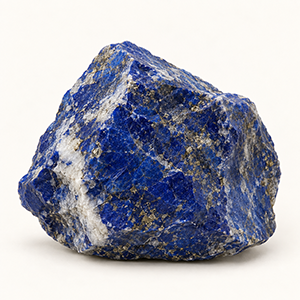 Lapis Lazuli
Deep blue stone from Afghanistan, once ground into the costliest blue in art.
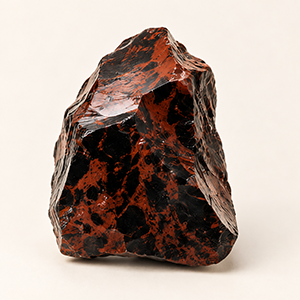 Mahogany Obsidian
Black and red-brown volcanic glass, once mirrors, linked today with resilience.
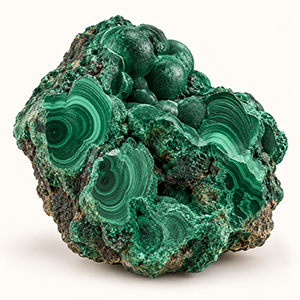 Malachite
Banded green copper mineral, once eye paint and pigment, linked today with change.
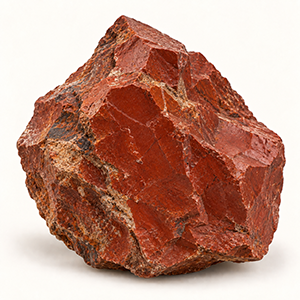 Red Jasper
Opaque red stone of Egyptian amulets and seals, linked today with endurance.
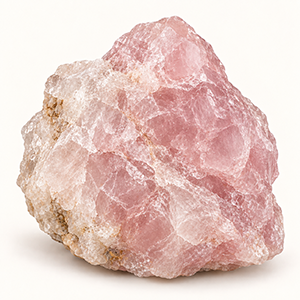 Rose Quartz
Pink quartz, worn for thousands of years, linked today with love and the Heart.
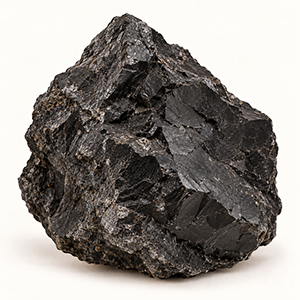 Shungite
Ancient carbon-rich rock from Karelia, linked today with protection and clearing.
 Smoky Quartz
Smoky brown quartz, Scotland’s cairngorm, linked today with gentle grounding.
 Turquoise
Sky-blue copper mineral, treasured from Egypt to Persia, linked today with protection.