Meaning, symbolism, healing traditions, uses and care
Black Tourmaline
Black tourmaline is one of the most recognizable stones in contemporary crystal practice: deeply striated, and almost black enough to absorb the light around it. It is the stone of protection and boundaries, connected with the Root.
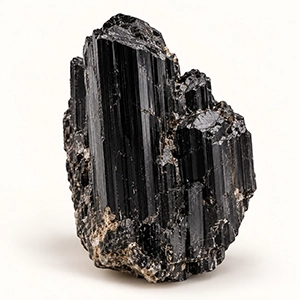
That reputation is modern, and its documented history is more nuanced: for centuries, different colors of tourmaline were mistaken for other gemstones, and it was not clearly recognized as its own mineral group until modern mineralogy.
At a glance
- Color
- Black to very dark brown-black
- Mineral group
- Tourmaline
- Common species
- Schorl
- Hardness
- Approximately 7 to 7.5 on the Mohs scale
- Crystal system
- Trigonal
- Important sources
- Tourmaline occurs worldwide, including Brazil, Africa, Pakistan, Afghanistan and the United States
- Energy center
- Root
Tourmaline is not one mineral but a group of related minerals that share a crystal structure while varying widely in chemistry, which is why it comes in so many colors. Black tourmaline is usually schorl, the iron-rich member. Its crystals grow as long three-sided prisms with strong grooves running their length, which makes rough black tourmaline easy to recognize.
What black tourmaline represents today
In contemporary crystal and metaphysical traditions, black tourmaline is associated with protection, grounding, energetic boundaries, clearing and stability. Its character is firm, steady and containing: where smoky quartz feels light and translucent, black tourmaline feels defined, like a boundary.
That boundary does not mean rejecting people. It means staying connected without taking everything in: listening without carrying the whole conversation home, caring without becoming responsible for everything someone else feels. Even the confidence it stands for is quiet, closer to “I can remain myself while I am here” than to being seen.
A short history
Before modern mineralogy, gemstones were identified mainly by appearance, so green tourmaline could pass for emerald and red tourmaline for ruby. Black schorl had a quieter story. It was rarely faceted, but its dark look suited it to jewelry, including mourning jewelry. Its fame as a protection stone belongs mainly to contemporary traditions.
A stone that keeps a record
Tourmaline’s flexible chemistry makes it valuable to geologists. A crystal can keep chemical signatures through later geological events, recording the fluids it formed from and the changes in the rock around it. Some extremely old tourmaline grains preserve information from billions of years of Earth’s history. Physically, it records its environment; symbolically, it stands for staying steady within one.
What people often misunderstand about black tourmaline
The common shortcut is: “I absorb everyone’s energy, so I need black tourmaline.” The words sound alike. What sits underneath them often does not.
One person feels drained because they give too much, and firmer boundaries may be exactly right. Another feels overwhelmed because they are already hyper-aware of everything around them. A third already has strong boundaries but struggles to feel grounded inside them.
And some people are so focused on protection that very little gets close enough to become connection. For them, what is missing may be ease or trust, not more shielding.
Feeling exposed and feeling closed off can use the same language. They rarely call for the same support.
When black tourmaline may not be what you need
If you already meet people and places defensively, more protection may reinforce distance rather than balance; openness may be what needs strengthening.
If your boundaries are already rigid, the missing piece may not be stronger separation but learning where connection is safe.
If you feel heavy, withdrawn or cut off from enthusiasm, another dense Root-centered stone may not be what needs more support.
If most of your practice is about removing negativity or blocking energy, it may help to ask what you want to invite in as well.
None of this makes black tourmaline the wrong choice. Its protective character can be exactly right at a particular moment. Protection is simply one quality among many.
The My Crystal Code view
Wanting protection is not the same as needing it
Black tourmaline’s meaning is strong and useful, but it describes the stone, not you. Knowing what a crystal traditionally represents is not the same as knowing whether it is the right crystal for you right now. My Crystal Code looks at the whole person before suggesting any support: the person comes first, the crystal second.
How people use black tourmaline
- Grounding meditation: Hold a polished stone, or place black tourmaline near the feet.
- Carrying and jewelry: Carry it on demanding days, or wear it as a bracelet, pendant or beads.
- Entrances: Place it near a door as a symbolic boundary for a space.
- Workspaces: Keep it on a desk in settings that feel socially or energetically demanding.
- Boundary reflection: Hold it while journaling about where your energy ends and another person’s responsibility begins.
Caring for black tourmaline
- Cleaning: Warm water, mild soap and a soft brush.
- Heat: Avoid high heat and sudden temperature changes, which can cause fractures.
- Ultrasonic cleaning: GIA does not recommend ultrasonic cleaning for tourmaline.
- Steam: Steam cleaning is not recommended.
- Impact: Protect natural crystals from sharp blows, especially specimens with thin projections or existing fractures.
- Storage: Store it apart from harder gemstones that could scratch polished surfaces.
Questions people often ask
Is black tourmaline the same as schorl?
Usually, yes. Most material sold as black tourmaline is schorl, the typically black, iron-rich species of the tourmaline group.
Why is it called tourmaline?
From the Sinhalese toramalli, linked with mixed or multicolored gems from Sri Lanka. Dutch merchants used it for colorful water-worn stones from the gem gravels of Ceylon.
Is black tourmaline actually electrical?
In a physical sense, yes. Tourmaline can develop an electrical charge when heated and electrical polarization under pressure. These pyroelectric and piezoelectric properties are mineral physics, not proof of energetic protection.
Can black tourmaline go in water?
Yes, for ordinary cleaning. Warm soapy water is the recommended method; long soaking is unnecessary.
Is black tourmaline the right crystal for me?
It may be. Its meaning tells you what the stone represents; whether protection is the support you need right now is a personal question, and that is where My Crystal Code begins.
Discover which crystals fit you right now
A crystal’s meaning is a starting point. The real question is which qualities, protection or something else entirely, need support in you right now.
Start your readingSources
- Gemological Institute of America (GIA): Tourmaline Description, History & Lore, October Birthstone and Care & Cleaning resources.
- GIA Gems & Gemology: Tourmaline chemistry, mineral species and its value as a geological record of rock-forming environments.
- Gemological research: Schorl as the common iron-rich black member of the tourmaline group.
More in the Crystal Library
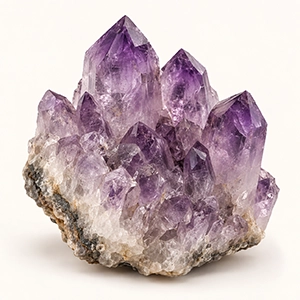 Amethyst
Purple quartz, once a stone of sobriety, linked today with calm and clarity.
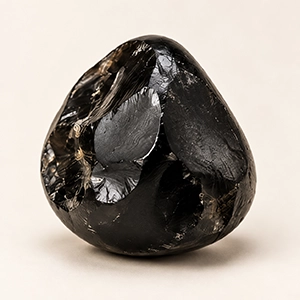 Apache Tear
Small obsidian pebbles from Arizona perlite, linked today with grief and release.
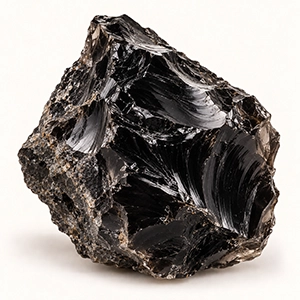 Black Obsidian
Natural volcanic glass, once blades and mirrors, linked today with grounding.
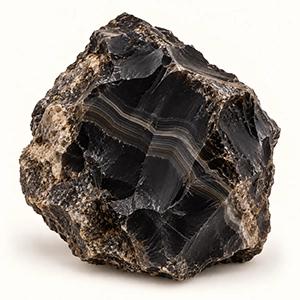 Black Onyx
Black chalcedony of Roman intaglios and cameos, linked today with boundaries.
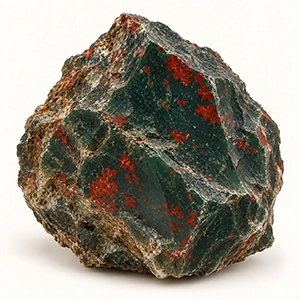 Bloodstone
Green stone flecked with red, the heliotrope of Rome, linked today with courage.
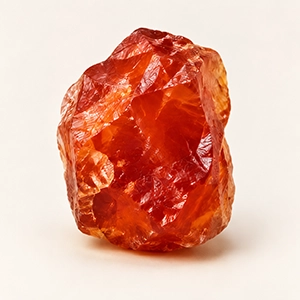 Carnelian
Orange-red chalcedony, carved since the Indus Valley, linked today with vitality.
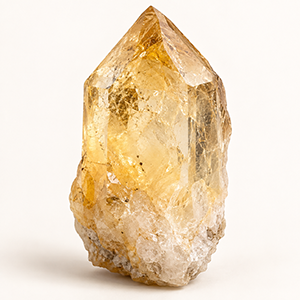 Citrine
Golden quartz, often heated amethyst, linked today with confidence and abundance.
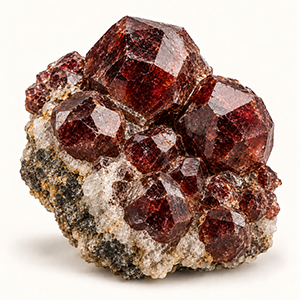 Garnet
A family of deep red gems, worn since ancient Egypt, linked today with vitality.
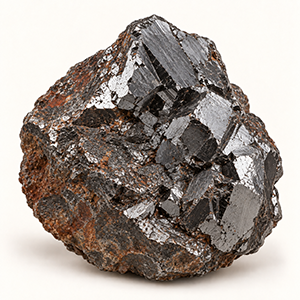 Hematite
Metallic iron mineral, once red ochre and pigment, linked today with grounding.
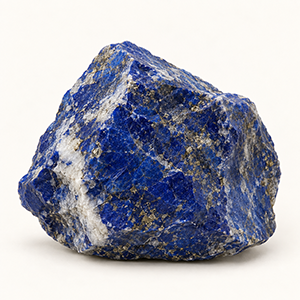 Lapis Lazuli
Deep blue stone from Afghanistan, once ground into the costliest blue in art.
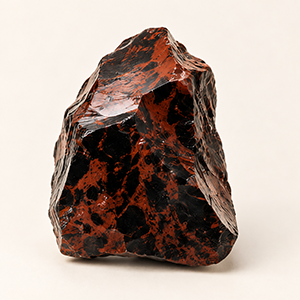 Mahogany Obsidian
Black and red-brown volcanic glass, once mirrors, linked today with resilience.
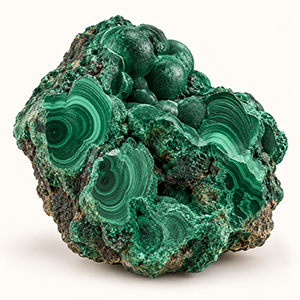 Malachite
Banded green copper mineral, once eye paint and pigment, linked today with change.
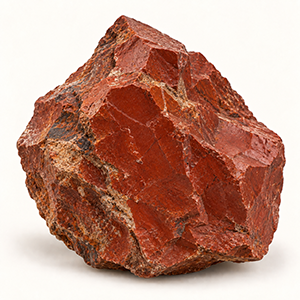 Red Jasper
Opaque red stone of Egyptian amulets and seals, linked today with endurance.
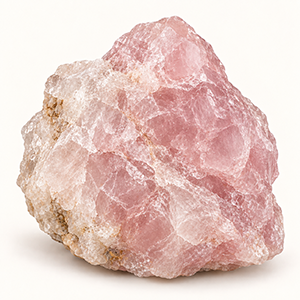 Rose Quartz
Pink quartz, worn for thousands of years, linked today with love and the Heart.
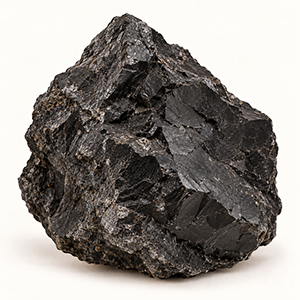 Shungite
Ancient carbon-rich rock from Karelia, linked today with protection and clearing.
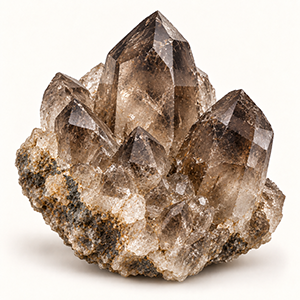 Smoky Quartz
Smoky brown quartz, Scotland’s cairngorm, linked today with gentle grounding.
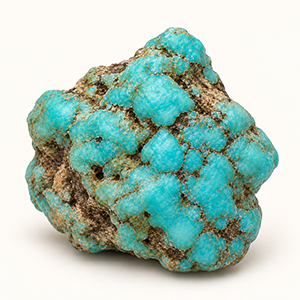 Turquoise
Sky-blue copper mineral, treasured from Egypt to Persia, linked today with protection.